
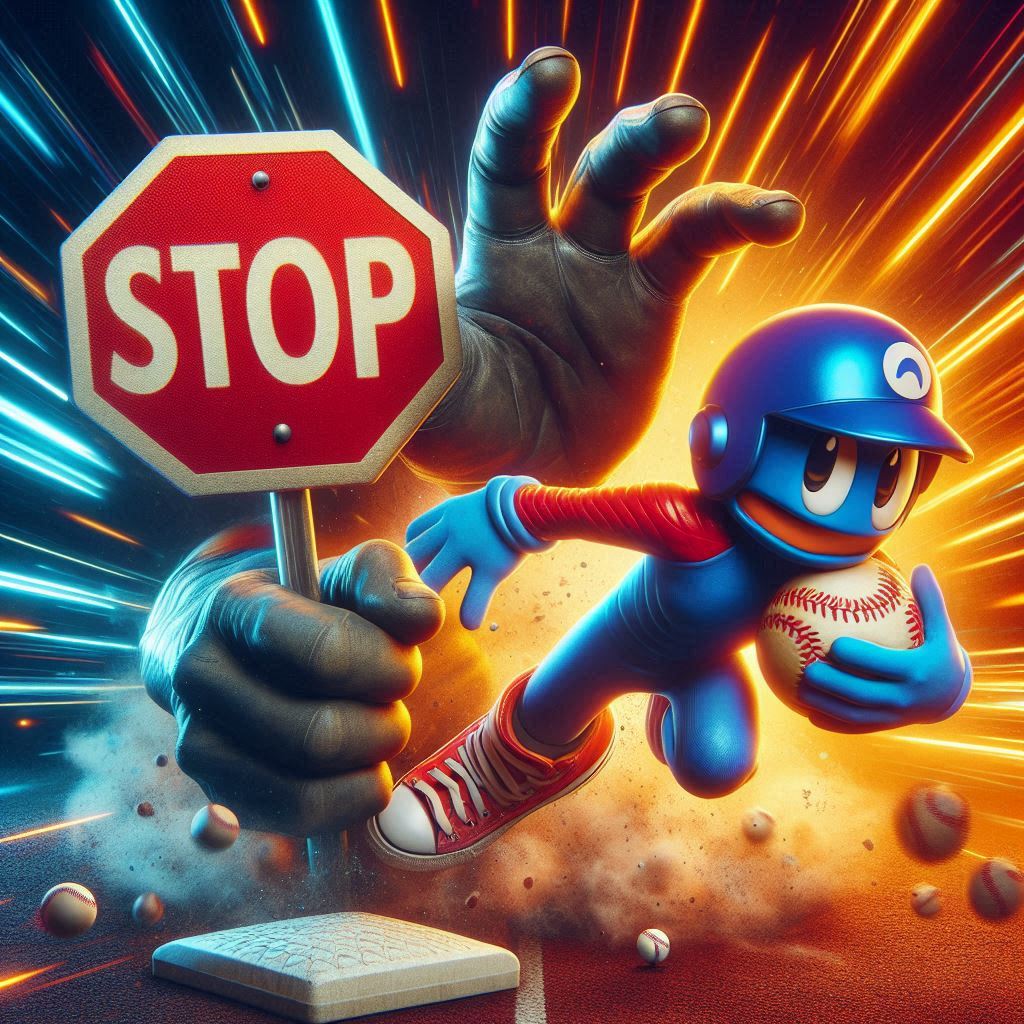
Creative success must be built, not regulated. This idea is simple to agree to in principle but proves difficult to apply in practice. Creators in nearly every sector face a competitive environment, and it can be tempting to find some kind of edge. Most people involved in creative fields are also expected to be active on social media. A side effect of this expectation is that creators who would normally be focused on producing good work can become ‘very online’. As a result, when creators look for an edge in their field, they apply things that work online that do not work in the real world. One frequent example of this tendency is what I will call ‘stolen bases’.
A stolen base (aside from its normal meaning in baseball) is an effort to skip over a necessary but difficult or inconvenient part of the production and distribution of a creative work. A stolen base is not ineffective by definition, but is ineffective in practice. One common example of a stolen base is a declaration of illegitimacy. Some undesirable object (a feature, procedure, person, anything goes) is declared illegitimate, with the implicit or explicit assumption being that it no longer needs to be engaged with. This tactic is quite common once you look for it. Consider how often a work is dismissed because it’s ‘not a game’ or even an entire form of media is dismissed as ‘not art.’
This tactic is effective in online spaces. A sufficiently unpopular individual can be effectively removed from a social network if enough momentum is built to encourage them to be blocked. People even volunteer to automate this process. It works because all the action is limited to the online space. Whatever entity is declared illegitimate effectively ceases to exist in the social network for the people who participate in the blocking, which is the intended outcome.
Very few of the problems that we encounter exist purely on social media and so the tactic is completely ineffective for most problems. For example, Unity Technologies announced a surprise and deeply unpopular fee structure that created an intense backlash. Twitter was full of developers announcing they were leaving Unity, the Unity3D subreddit became a fifth column for rival engines, and industry pundits updated their spreadsheets to falsely claim Unity would bankrupt game developers. However, most developers are not equipped to develop replacements for Unity, and they quickly discovered the limitations of the alternatives they had switched to. Whatever the merits of the case, developers were confronted with the fact that their skills from one engine were not immediately transferable and that some Unity features did not have direct replacements.
Some might rightly point out that Unity ultimately reversed its decision on the fee. This reversal, unfortunately, does not even qualify as a Pyrrhic victory. The vast majority of developers were not affected by the fee and so the reversal did not produce any savings. Unity did, however, engage in another round of unpopular cost reductions, including additional layoffs. Declaring the engine illegitimate did not change the reasons for using it, the quality of the alternatives, or the financial position of Unity. Everyone is worse off, except for the developers who were already large enough to see their profit margins affected by the fee.
The fallout is felt even in individual projects. I backed a promising Kickstarter from an experienced developer who was funding their first standalone game. One reason I backed the project was a Unity demo they made available during the campaign, showing that they could deliver on this kind of project. The project fell behind schedule and wound up on the wrong side of the COVID-19 pandemic. This project also decided to switch engines in response to the Unity fee announcement. The project is currently almost five years late from its original estimated delivery date. My initial sympathy for a developer facing circumstances beyond their control has now given way to annoyance at being treated as an interest-free loan to engage in a bit of activism. The consequences of this choice are not limited to the developer and publisher in question, but affect every subsequent Kickstarter that now needs to work harder to convince backers that they will be good stewards of the money they are given.
Problems in the real world cannot be willed away. Sid Meier himself can declare marketing orthogonal to game development — and thus illegitimate — and it will not change the fact that developers need to get the word out. Same goes for AI, microtransactions, unfavourable publishing terms, and every other developer irritant. There are no stolen bases.
This does not mean that creators need to abandon all principles and act like everyone else. It does require creators to assess what is a real problem and treat it seriously. Once the illusion of an easy social media solution is removed, the creator is confronted with the genuine difficulty of the problem. This quickly leads to the wonderfully simple clarifying questions “is this really an issue?” and “can I take this on right now?”
Creation is difficult enough without burdening the work with problems that do not matter to the final product and its intended audience. Stolen bases aren’t just an inappropriate solution, they actually give the illusion that creators can solve more than they can take on. Banishing these false solutions may not guarantee a real solution, but it will at least direct attention to the right problems and the resources available to solve them.
 SystemTalk